Finding JET's Next Big Thing: 14 New Propositions, One That Changed the Game
Strategic innovation · Zero to one · 6 months · Lead strategist
The impact
44% new customer acquisition during the UEFA Women's Euros - from a proposition that didn't exist when this project started
14 new growth propositions identified and sized - 7 progressed into development or discovery
Created a new innovation sprint methodology that permanently changed how the business approaches ambiguous growth opportunities
Broke down silos between Product and Commercial teams across global markets
Shifted the mindset of a business that didn't think of itself as innovative, proving itself wrong
The situation
Just Eat Takeaway was known for one thing: delivering prepared meals to your door. But the business had a bigger ambition - to expand into new food moments beyond the home. Customers on the move. Group orders. In-venue ordering. Unknown, unknowns.
The opportunity was enormous. The space was completely undefined. And the question wasn't just "which opportunities are worth going for", it was "how do you even begin to explore a market that doesn't exist yet?"
This was a zero to one brief. No clear methodology to reach for. In reality the data existed: market data, commercial data from existing corporate ordering solutions, fragmented dashboards scattered across the business. A mess, but a gold mine for innovation that nobody had found the golden thread running through…yet.
What the business thought going in
That this was primarily a product problem. What the research revealed was that it was equally a commercial one — and that the two functions had been operating in silos that were actively limiting JET's ability to innovate.
Across different markets, Commercial teams were already experimenting with creative solutions that Product had no visibility of. The gap between what was commercially possible and what Product was building for was a structural problem hiding in plain sight.
The approach
Partnering with a service designer, we designed and built the entire programme from scratch - creating a roadmap for a space nobody had mapped before. From day one we worked in close partnership, bringing together strategic research and design thinking from the outset rather than as a downstream step. This wasn't research that got handed to a designer at the end. It was a genuinely collaborative process where insight and design evolved together.
Before any new research could begin, there was existing data to excavate - messy commercial dashboards, market data and corporate ordering analytics spread across the business with no connective tissue between them. Synthesising this into a coherent picture was the unglamorous but essential first step that shaped everything that followed.
Getting senior buy-in early was non-negotiable. Kickoff interviews with the Director of Design, Chief Product Officer and Director of Delivery were essential to understand where the business's appetite for risk actually sat and to create the conditions for bold thinking later.
From there: horizon scans across trends, markets and competitors. Opportunity sizing. 54 stakeholder interviews across global markets that revealed just how differently Commercial teams in different countries were approaching innovation. International ethnography. Co-creation focus groups with 35 participants. A concept validation survey across 5,000 people. And throughout — a constant synthesis of sales and product data to pressure-test every opportunity against commercial reality.
Methods weren't chosen from a standard playbook. Every decision was made in service of one goal: ruthlessly giving direction in an ambiguous space with a tight budget.
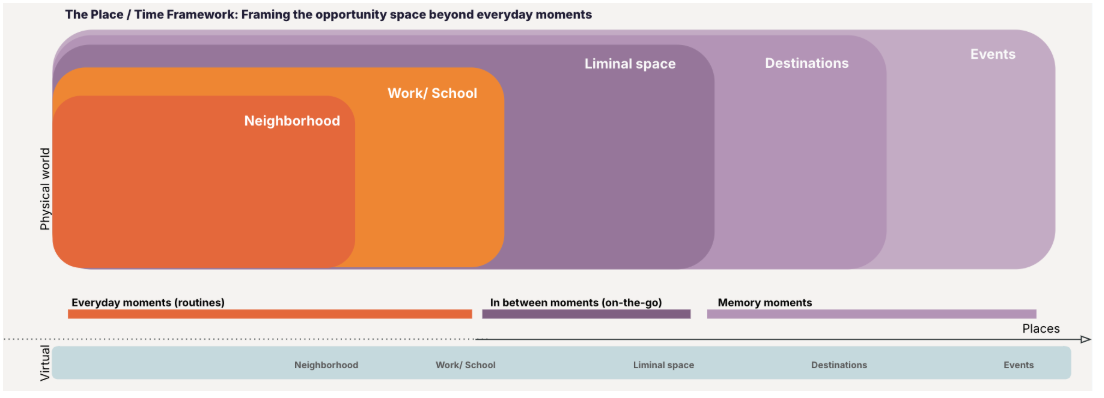
For clarity of storytelling and aligning stakeholders, each identified proposition was mapped into a framework we created: the Time/ Place framework:
The workshop that changed the culture
Not everyone believed in this work. Some stakeholders — more comfortable with execution than exploration — thought innovation research was a distraction. A nice-to-have, not a serious business activity.
An additional partnership with an interaction designer was vital here — propositions weren't just presented as findings but shown as designed concepts people could react to, challenge and build on. That tangibility was what shifted the sceptics. You can argue with a slide but it's much harder to dismiss something you can see and touch.
Sceptics who arrived unconvinced left with a different understanding of what was possible. The energy of the sessions did as much work as the findings themselves.
The result was was the creation of a new innovation sprint methodology I went on to run in our New Ventures pillar — a leaner, more agile approach to rapidly exploring and testing opportunities before committing product resource. A permanent change to how the business innovates.
Why in-stadium ordering won
Of the 14 propositions identified, in-stadium ordering rose to the top for reasons that were as strategic as they were practical. JET's sponsorship of UEFA created a natural launchpad — a low-risk, low-build opportunity to test the proposition in a real environment before committing significant engineering resource.
The research identified the commercial logic. The business case connected it to JET's existing strategic assets. And the timing — with the UEFA Women's Euros 2025 on the horizon — created a window to move fast.
The result: 44% new customer acquisition in the pilot market. A proposition that started as one of 14 ideas on a whiteboard is now rolling out across Europe.
The outcomes
A market that didn't exist at the start of this project now has a validated proposition generating new customers at scale. Seven of the 14 opportunities identified are still in active development or discovery. A new innovation methodology was created that changed how the business approaches ambiguous growth problems. And Product and Commercial — two functions that had been working in parallel rather than together — found a shared language for innovation.
What I'd do differently
Surface the Commercial and Product gap earlier and more explicitly. The divergence between how different markets were approaching innovation was one of the most important findings — but it emerged through the research rather than being designed for. Building a specific diagnostic for organisational innovation readiness into the kickoff phase would have accelerated the structural fix alongside the proposition development.
And as with all large-scale programmes: AI tools for stakeholder coordination, interview scheduling and first-pass synthesis would have freed up significant time for the strategic thinking that only a human can do.