Defining JET's Retail Media Strategy: From Ambiguity to tapping a $153bn Opportunity
Strategic transformation · B2B & B2C · 6 months · Solo product strategist
The impact
"A masterclass in what research can do. From the very beginning you grasped the complex topic that is digital advertising and handled interviews with experts with great skill. The maturity framework and workshop has been vital to give us direction for the roadmap — without it I don't know where we'd be." — Head of Product, Just Eat Takeaway
Influenced the 5-year product and commercial roadmap for JET’s Retail Media proposition to double it’s retail media revenue to £400m by 2027
Directly contributed to a 11.5% sales uplift for FMCG partner experiment that wouldn't have happened without this work
Provided the strategic confidence to onboard Rokt - an AI-enabled platform partner that became central to JET's retail media infrastructure
Resolved a critical misalignment between Commercial and Product leadership that had been blocking progress
Reframed how hundreds of people across the business were thinking about the industry
Delivered across 50+ stakeholders including global partners Unilever and PepsiCo
The situation
Retail media is a $153bn industry and one of the fastest growing revenue opportunities in digital commerce. JET had the audience, the data and the ambition. What it didn't have was a clear strategy for how to build this at scale — or an honest picture of whether its current approach would work.
Sales had set ambitious targets. Product had a roadmap. And nobody had mapped the fundamental question: how ready was JET's eco-system to actually participate in a rapidly advancing retail media landscape?
The problem nobody had named
The business had been trying to sell a flimsy one-size-fits-all proposition into a partner base of extraordinary diversity. Some partners had sophisticated media planning teams, API infrastructure and dedicated digital marketing budgets. Others had never run a digital ad in their lives.
This wasn't just a product problem. It was a strategic one. And until it was named, no amount of roadmap planning would fix it.
The approach
Six months. Two audiences. A mandate to make sense of an industry the business had been sinking, not swimming in, for years.
I brought Commercial into the process from day one - running kickoff workshops with leaders across Product, Design, Commercial and Marketing to align teams, surface existing knowledge and smooth over relationships before the work even began. Rumsfeld Matrix to make sense of a messy brief.
For partners:
User Interviews: 45 in-depth conversations including carefully handled sessions with future commercial clients like Unilever and PepsiCo - organisations that needed to trust JET before they'd spend with it.
‘Innovation Frontier’ (Expert) Interviews: Further expert interviews with senior figures across the retail media industry to benchmark what best in class actually looked like and bring genuine outside-in thinking into a business that had been looking inward.
Jobs to Be Done (JTBD): Mapping insights into key partner jobs, to inform the discovery process.
Concept Testing: Rapid interviews with partners to explore and test potential solutions.
For customers:
Usability Testing: Partnered with a UX Designer to design and test an end-to-end prototype to explore how advertising could add value to the experience rather than erode the trust JET had spent years building.
A/B Testing & Experimentation: Launched live in product to inform design playbook for future advertisements.
Throughout: sole strategist globally, C-suite visibility, an organisation in flux and a category where limited precedent existed to build on.
The framework that changed the conversation
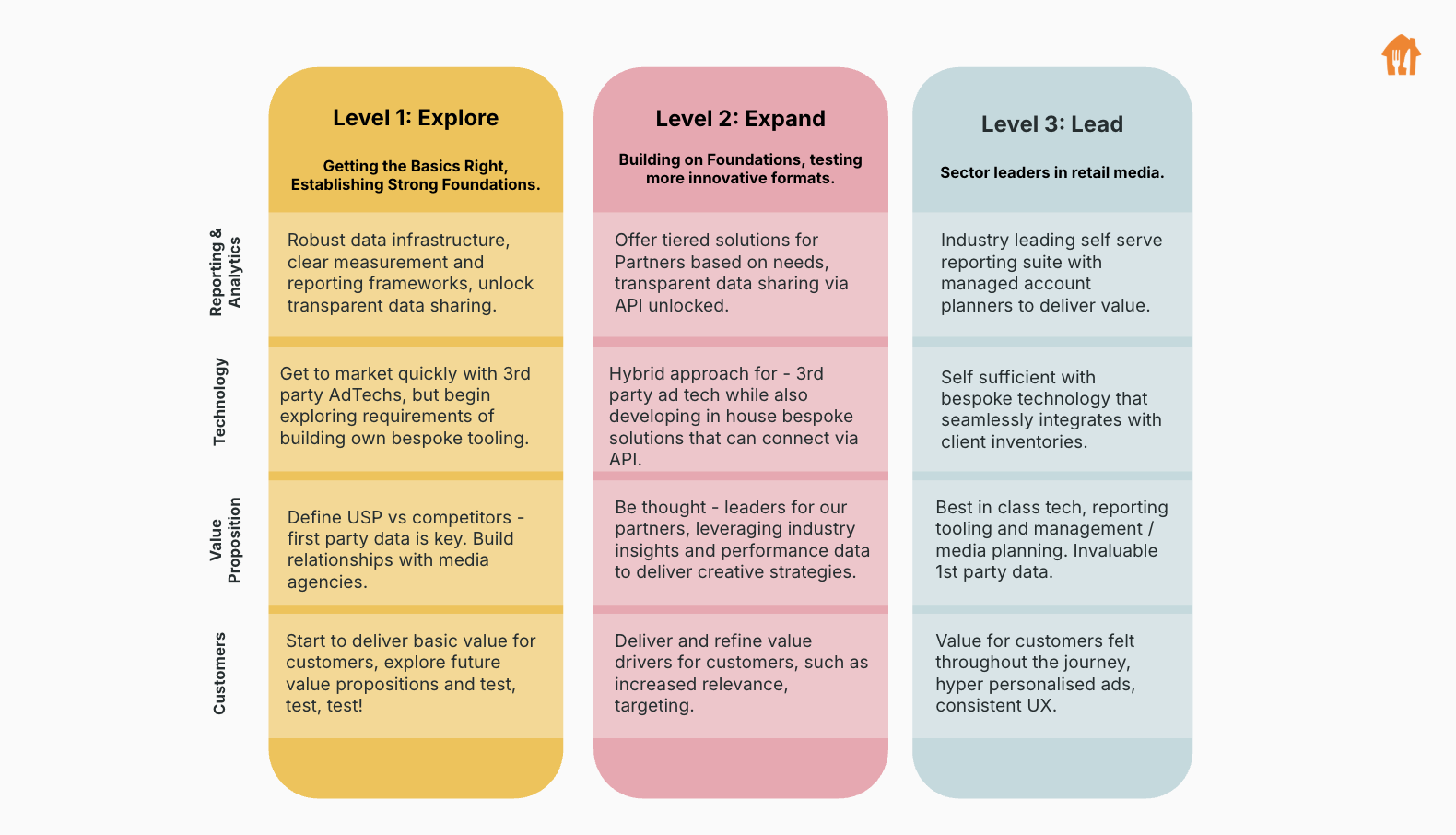
To make the partner diversity legible - and actionable - I developed a three-level maturity framework: Explore, Expand, Lead. Mapping where each partner sat across reporting and analytics, technology, value proposition and customer experience.
This became the strategic organising principle for everything that followed.
In the workshop I ran with Product and Commercial leadership, something important happened. The Commercial Director saw for the first time exactly how far JET had to go and how long it would realistically take to build. The sales targets she had set hadn't been informed by the product reality. The Product Director finally had a framework that made the complexity legible to the rest of the business.
Two teams that had been working from different pictures of reality aligned around a shared roadmap in a single session.
Sample of Maturity Framework used to steer workshops and align hundreds of stakeholders.
The outcomes
The maturity framework shaped the product roadmap directly, giving the business a clear now, next, later structure for building out its retail media capability.
Expert interviews with industry leaders reframed the strategic ambition of the entire initiative — shifting hundreds of people from tactical thinking to genuine industry leadership positioning.
My insights provided the confidence to onboard Rokt, an AI-enabled platform partner, as a key technology partner — a decision that directly shaped JET's retail media infrastructure.
Most powerfully: sessions with Unilever gave them the confidence to act immediately. They launched experiments starting with Ben & Jerry's. This led directly to the creation of a new product page and a 12% uplift in Unilever sales.
Revenue that wouldn't have existed without this work.
What I'd do differently
The logistics of coordinating across 50+ globally distributed stakeholders — identifying the right people, scheduling interviews, managing communications across teams — consumed significant time that could have been spent on the strategic work itself.
Today I'd use AI tools to automate much of that coordination layer: using Claude or similar to draft and personalise stakeholder communications at scale, AI scheduling tools to manage interview logistics across time zones, and NotebookLM to synthesise findings across a large volume of interviews faster.
The thinking and the judgment would still be mine. But the scaffolding would be faster — which on a project this size would have meaningfully accelerated the timeline.